

Businesses increasingly rely on cloud technologies to support daily operations, customer experiences, and long-term growth. However, moving applications and data to the cloud is only one part of building a reliable IT environment. Organizations must also maintain infrastructure, strengthen cybersecurity, monitor system performance, manage backups, and prepare for unexpected disruptions. These responsibilities require continuous expertise that many internal IT teams cannot provide on their own. Managed cloud services in Canada help businesses address these operational challenges while improving security, scalability, and system availability.
Working with a managed cloud service provider allows organizations to shift routine infrastructure management to experienced professionals. Rather than spending valuable resources maintaining servers, applying security updates, or responding to outages, businesses can focus on innovation, customer service, and strategic growth. Managed cloud environments combine proactive monitoring, technical support, cloud optimization, disaster recovery, and security management into a comprehensive service model designed to keep critical systems operating efficiently.
This guide explains how managed cloud services work, the technologies they include, the advantages they provide, and the factors organizations should evaluate when selecting a long-term cloud partner.
Key Takeaway
Cloud adoption alone does not guarantee better performance or stronger security. Businesses achieve greater value when experienced professionals continuously manage cloud infrastructure, optimize performance, protect critical systems, and maintain business continuity through comprehensive managed cloud services.
What Are Managed Cloud Services and Why Businesses Are Adopting Them
Cloud technology has evolved beyond simple online storage and virtual servers. Modern organizations require integrated solutions that support applications, users, security, compliance, and business continuity across increasingly complex IT environments.
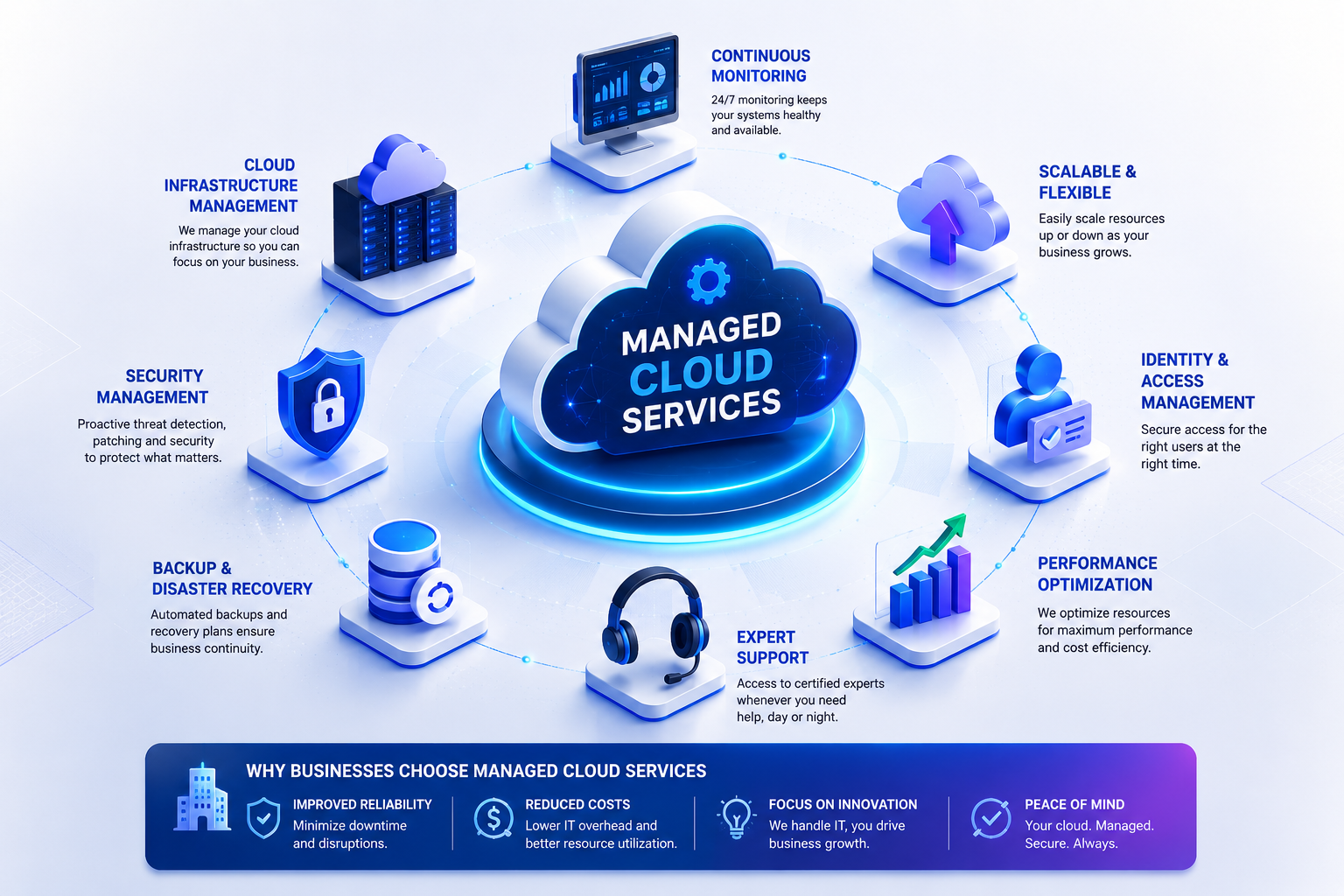
Managed cloud services provide ongoing administration and operational support for cloud infrastructure. Instead of assigning every cloud responsibility to internal IT staff, businesses work with specialists who monitor, maintain, secure, and optimize cloud environments around the clock.
These services help organizations reduce operational complexity while improving infrastructure reliability and long-term performance.
What Managed Cloud Services Include
Managed cloud services encompass far more than infrastructure hosting. Service providers oversee the health and operation of cloud environments throughout their lifecycle.
Typical services include:
- Cloud infrastructure management
- Server provisioning
- Operating system maintenance
- Continuous monitoring
- Performance optimization
- Backup management
- Disaster recovery planning
- Firewall administration
- Identity and access management
- Patch management
- Security monitoring
- Capacity planning
- Technical support
- Compliance assistance
Rather than reacting only when problems occur, providers proactively identify performance issues before they affect business operations.
Difference Between Cloud Hosting and Managed Cloud Services
Many organizations mistakenly use cloud hosting and managed cloud services interchangeably. Although related, they serve different purposes.
| Cloud Hosting | Managed Cloud Services |
|---|---|
| Provides computing resources | Manages the complete cloud environment |
| Customer handles administration | Provider performs ongoing administration |
| Limited operational support | Continuous monitoring and optimization |
| Infrastructure only | Infrastructure plus security, maintenance, backups, and support |
| Reactive support | Proactive management |
Cloud hosting supplies virtual infrastructure. Managed services build upon that infrastructure by providing the operational expertise required to keep systems secure, available, and optimized.
Business Benefits of Proactive Cloud Management
Organizations increasingly adopt managed cloud services because reactive IT management creates unnecessary operational risks.
Key advantages include:
Improved Reliability
Continuous monitoring identifies infrastructure issues before they become service interruptions.
Enhanced Security
Providers regularly update operating systems, patch vulnerabilities, monitor threats, and strengthen security controls.
Predictable Operations
Routine maintenance follows structured processes that minimize unexpected downtime.
Better Resource Utilization
Cloud resources are continually optimized to reduce waste while maintaining application performance.
Access to Specialized Expertise
Businesses can gain access to experienced cloud engineers without expanding internal staffing.
Faster Issue Resolution
Dedicated support teams identify root causes quickly and implement corrective actions before problems escalate.
How Managed Cloud Services Support Business Continuity
Business continuity depends on more than maintaining application uptime.
Organizations must prepare for:
- Hardware failures
- Software corruption
- Cybersecurity incidents
- Human error
- Network disruptions
- Natural disasters
- Data loss
Managed cloud environments incorporate redundancy, automated backups, disaster recovery planning, and documented recovery procedures to reduce operational disruption during unexpected events.
Rather than rebuilding systems from scratch, organizations recover workloads through structured recovery processes designed in advance of incidents.
Ready to simplify your cloud operations? Connect with Pathway Communications to discuss managed cloud solutions tailored to your business.
Core Components of Modern Managed Cloud Infrastructure
Successful cloud environments consist of multiple interconnected technologies working together. Each component supports performance, availability, and security across the organization’s digital infrastructure.
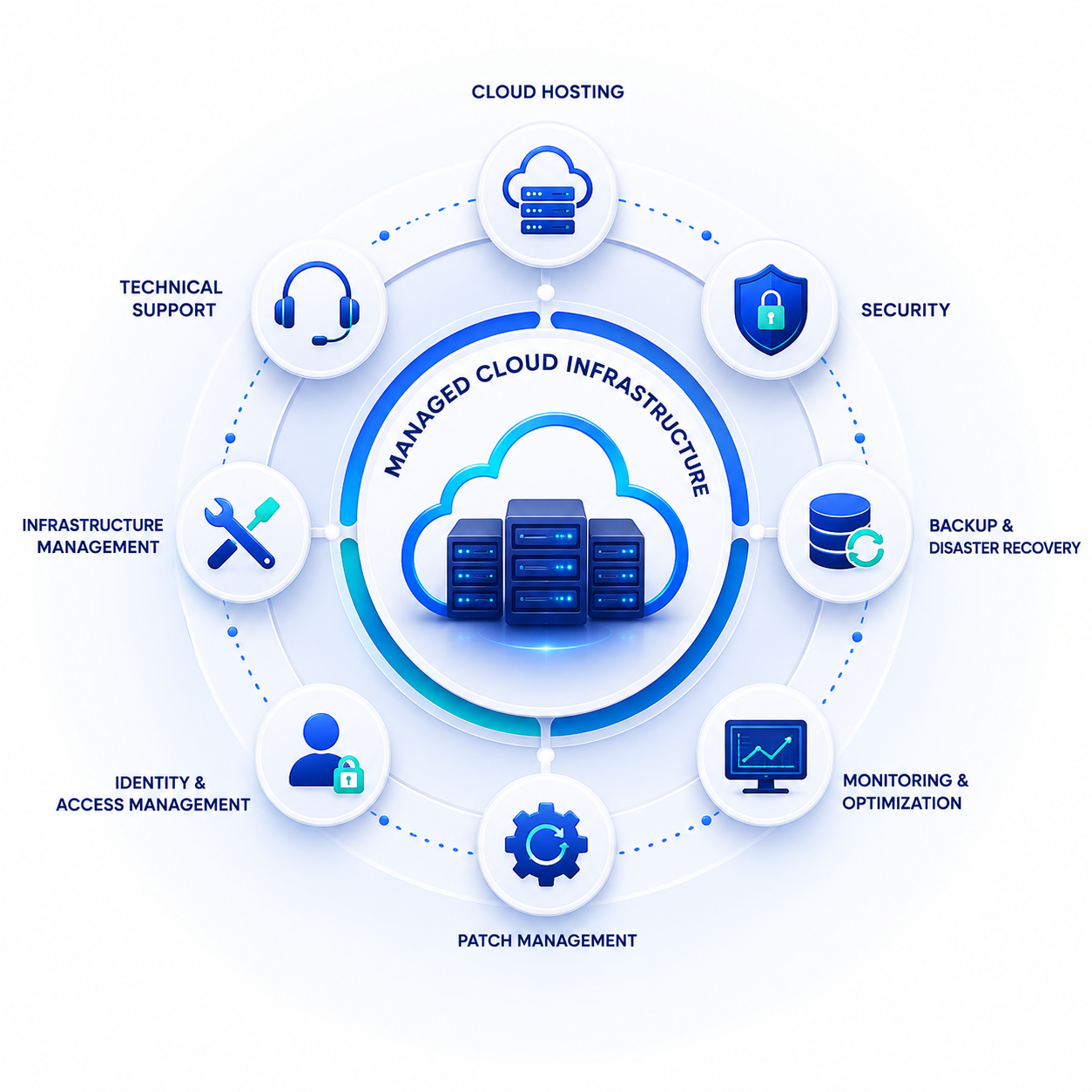
Cloud Hosting and Infrastructure Management
Infrastructure forms the operational foundation of every cloud environment.
Cloud administrators manage:
- Virtual machines
- Storage resources
- Networking
- Compute capacity
- Load balancing
- Virtual private networks
- Resource allocation
They continuously monitor utilization levels to ensure systems remain responsive as workloads change.
Infrastructure management also includes:
- Capacity forecasting
- Server lifecycle management
- Resource optimization
- Performance tuning
- Configuration management
Proper infrastructure management prevents resource shortages while avoiding unnecessary cloud spending.
Security Monitoring and Firewall Management
Cloud environments remain frequent targets for cyberattacks because they often host business-critical applications and sensitive information.
Security management includes multiple defensive layers designed to detect and prevent unauthorized activity.
These services commonly include:
- Firewall configuration
- Intrusion detection
- Threat monitoring
- Traffic inspection
- Network segmentation
- Vulnerability assessments
- Security policy enforcement
Modern firewalls protect much more than network boundaries. They analyze application traffic, detect suspicious behaviour, enforce access policies, and support compliance requirements across distributed cloud environments.
Read more on how a firewall solution strengthens modern cloud security.
Backup and Disaster Recovery Services
Backups remain one of the most valuable components of managed cloud infrastructure.
Organizations cannot rely solely on infrastructure redundancy because accidental deletion, ransomware, software corruption, or human error can still compromise production systems.
Comprehensive backup strategies include:
- Automated backup scheduling
- Multiple recovery points
- Offsite replication
- Encryption
- Recovery validation
- Long-term retention
Disaster recovery planning extends beyond backup creation.
Providers establish documented recovery procedures that define:
- Recovery priorities
- Recovery time objectives
- Recovery point objectives
- Application dependencies
- Communication plans
- Infrastructure restoration processes
Regular testing ensures recovery plans remain effective as systems evolve. Do you wonder why businesses are moving data recovery services to the cloud?
Performance Monitoring and Optimization
Cloud performance continuously changes as workloads fluctuate.
Managed providers monitor:
- CPU utilization
- Memory consumption
- Storage performance
- Network latency
- Database response times
- Application availability
- Resource bottlenecks
Performance optimization may involve:
- Scaling infrastructure
- Redistributing workloads
- Optimizing storage
- Adjusting resource allocation
- Improving application efficiency
Continuous monitoring helps organizations avoid degraded user experiences while controlling infrastructure costs.
Patch Management and Software Updates
Unpatched systems create unnecessary operational and security risks.
Managed providers maintain structured update processes for:
- Operating systems
- Virtual machines
- Security software
- Databases
- Third-party applications
- Infrastructure services
Updates undergo planning and testing to minimize operational disruption.
Regular maintenance reduces vulnerabilities while improving system stability.
Identity and Access Management
Access control remains one of the most important elements of cloud security.
Identity management ensures that only authorized users gain access to business systems.
Key controls include:
- Multi-factor authentication
- Role-based permissions
- User provisioning
- Privileged account management
- Single sign-on
- Access auditing
Organizations reduce security risks by granting users only the permissions necessary to perform their responsibilities.
Build a more secure and resilient IT environment with the support of Pathway Communications and experienced cloud professionals.
Choosing the Right Managed Cloud Service Provider
Selecting a cloud partner affects far more than infrastructure performance. The provider becomes an extension of the organization’s technology team and plays an ongoing role in security, operational continuity, and business growth.
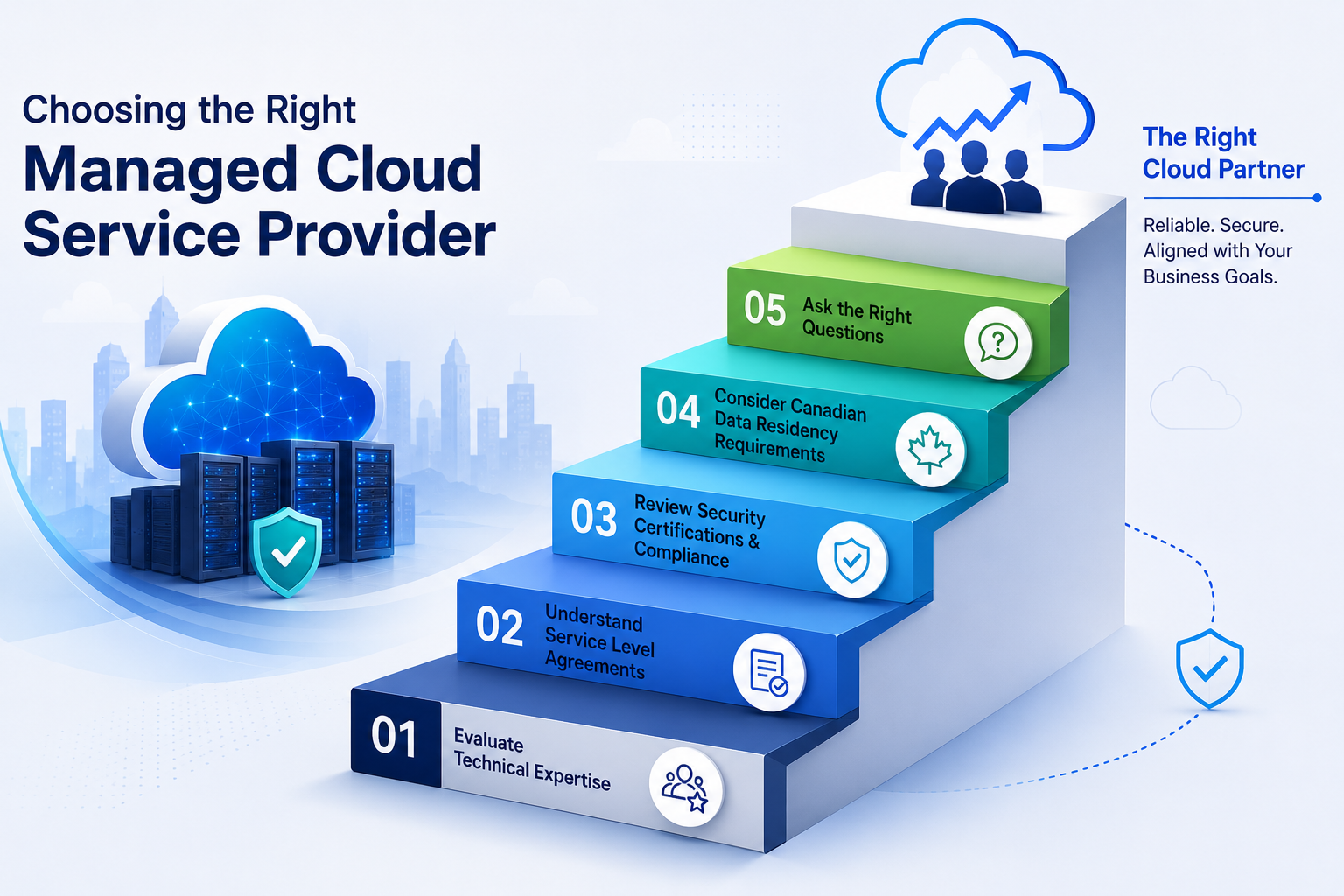
Choosing solely on cost often results in service limitations that lead to higher operational expenses over time.
Organizations should evaluate technical capabilities, support quality, governance practices, and long-term strategic alignment before making a decision.
Evaluating Technical Expertise
Cloud environments have become increasingly sophisticated.
Providers should demonstrate experience managing:
- Public cloud platforms
- Private cloud infrastructure
- Hybrid environments
- Virtualization
- Networking
- Security architecture
- Backup technologies
- Disaster recovery
- Migration planning
Technical expertise should extend beyond implementation to include ongoing optimization and operational support.
Understanding Service Level Agreements
Service level agreements establish measurable expectations between businesses and providers.
Organizations should review:
- Guaranteed uptime
- Support response times
- Incident escalation procedures
- Maintenance windows
- Monitoring responsibilities
- Recovery commitments
- Performance reporting
Well-defined agreements create accountability while reducing uncertainty during operational incidents.
Security Certifications and Compliance
Security capabilities should remain a primary evaluation criterion.
Businesses should understand how providers manage:
- Security monitoring
- Compliance reporting
- Data protection
- Encryption
- Access management
- Incident response
- Risk assessments
Organizations operating within regulated industries should also evaluate experience supporting applicable compliance frameworks.
Canadian Data Residency Considerations
Many Canadian organizations prefer data to remain within Canadian jurisdictions due to privacy, regulatory, contractual, or operational requirements.
A qualified provider should clearly explain:
- Data storage locations
- Backup locations
- Replication strategies
- Cross-border data movement
- Privacy controls
- Compliance support
Understanding these factors helps organizations align cloud operations with governance requirements.
Questions Businesses Should Ask Before Signing a Contract
Before selecting a provider, organizations should ask practical operational questions.
Examples include:
- How is infrastructure monitored?
- What backup frequency is provided?
- How are security incidents handled?
- What disaster recovery testing is performed?
- Who performs software updates?
- How quickly are support requests addressed?
- What reporting is available?
- How is cloud performance optimized?
- What happens during unexpected outages?
- How are future infrastructure expansions managed?
Detailed answers provide valuable insight into the provider’s operational maturity.
Partner with Pathway Communications to strengthen your cloud strategy with reliable, secure, and scalable managed cloud services.
Multi-Cloud and Hybrid Cloud Strategies Explained
Modern organizations rarely rely on a single deployment model.
Business requirements often lead to environments that combine multiple cloud platforms with existing on-premises infrastructure. Selecting the appropriate architecture depends on operational priorities, regulatory requirements, application design, and long-term growth objectives.
Understanding the differences between deployment models allows organizations to build flexible infrastructure that balances performance, security, and cost.
Understanding Common Cloud Deployment Models
| Deployment Model | Primary Characteristics | Common Use Cases |
|---|---|---|
| Public Cloud | Shared infrastructure operated by a cloud provider | Business applications, web services, scalable workloads |
| Private Cloud | Dedicated infrastructure for one organization | Sensitive workloads, regulated industries |
| Hybrid Cloud | Combines private infrastructure with public cloud resources | Gradual migration, compliance, workload flexibility |
| Multi Cloud | Uses services from multiple cloud providers | Redundancy, specialized services, vendor diversification |
Each model offers distinct operational advantages depending on business objectives.
When Hybrid Cloud Is the Right Choice
Hybrid cloud environments combine existing infrastructure with public cloud services, allowing organizations to modernize gradually rather than replacing all systems simultaneously.
Common reasons businesses choose hybrid cloud include:
- Protecting previous infrastructure investments
- Supporting legacy applications
- Meeting regulatory requirements
- Improving disaster recovery capabilities
- Scaling workloads during demand spikes
- Separating sensitive and non-sensitive workloads
Meeting the challenges of executing hybrid cloud strategy also allows organizations to migrate applications in phases while minimizing operational disruption.
Managing Multi-Cloud Environments
As businesses adopt specialized services from multiple cloud providers, infrastructure management becomes increasingly complex.
A multi-cloud strategy may improve flexibility by allowing organizations to select the most appropriate platform for different workloads. However, it also introduces challenges related to visibility, governance, security, performance monitoring, and operational consistency.
Working with an experienced managed service provider helps organizations coordinate resources across multiple cloud environments while maintaining centralized oversight.
Read this blog on how a cloud service provider can help your organization conquer multi-cloud challenges.
Managed Cloud Hosting Services Versus Traditional On-Premises Infrastructure
For many years, organizations relied on physical servers located within their own facilities. While this approach gave businesses direct control over hardware, it also required significant investments in equipment, maintenance, security, and skilled IT personnel. As technology requirements became more complex, many organizations shifted toward managed cloud hosting services to improve flexibility and reduce operational overhead.
Today, the decision is no longer simply about replacing servers. It involves selecting an infrastructure model that best supports business continuity, security, scalability, and long-term growth.
Comparing Managed Cloud Hosting and On-Premises Infrastructure
| Decision Factor | Managed Cloud Hosting Services | Traditional On-Premises Infrastructure |
|---|---|---|
| Initial investment | Lower upfront infrastructure costs | Significant hardware investment |
| Scalability | Resources expand as business needs change | Expansion requires new hardware purchases |
| Maintenance | Provider performs ongoing maintenance | Internal IT team manages infrastructure |
| Disaster recovery | Integrated backup and recovery options | Business develops and maintains recovery systems |
| Security updates | Centrally managed and regularly applied | Internal teams schedule and deploy updates |
| Remote accessibility | Built for secure remote access | Often requires additional infrastructure |
| Hardware lifecycle | The provider refreshes infrastructure | The business replaces aging equipment |
| IT staffing | Reduced infrastructure management workload | Greater internal administration responsibilities |
Neither deployment model fits every organization. Businesses should evaluate operational requirements, compliance obligations, application workloads, and long-term growth plans before selecting an infrastructure strategy.
Capital Expenses Versus Operational Expenses
Traditional infrastructure often requires large capital investments in servers, networking equipment, storage systems, cooling, and physical facilities. Hardware must also be upgraded periodically as technology evolves.
Managed cloud environments shift much of this investment toward predictable operating expenses. Organizations gain access to enterprise infrastructure without continually purchasing and maintaining physical hardware. This approach also allows businesses to scale resources according to demand rather than investing in excess capacity that remains underutilized.
Business Flexibility and Scalability
Business requirements rarely remain static.
Seasonal demand, organizational growth, acquisitions, and new digital initiatives often require additional computing resources with little notice.
Managed cloud environments support this flexibility by allowing organizations to scale computing capacity up or down without replacing physical infrastructure. Additional storage, processing power, and virtual resources can typically be provisioned much faster than expanding traditional server environments.
This scalability enables businesses to respond more quickly to changing operational demands.
Remote Workforce Enablement
Modern workforces increasingly operate from multiple locations.
Employees require secure access to applications, collaboration platforms, customer information, and business systems regardless of where they work.
Managed cloud hosting supports secure remote connectivity through centralized identity management, encrypted communications, and controlled access policies. Organizations can provide consistent user experiences while maintaining appropriate security controls across distributed teams.
Maintenance Responsibilities
Maintaining physical infrastructure requires continuous effort.
Internal IT departments typically manage:
- Hardware monitoring
- Server replacements
- Software updates
- Operating system maintenance
- Capacity planning
- Security patching
- Infrastructure troubleshooting
Managed cloud providers assume many of these operational responsibilities, allowing internal technology teams to focus on strategic initiatives rather than routine infrastructure administration.
When Traditional Infrastructure Still Makes Sense
Although cloud adoption continues to expand, some organizations maintain on-premises infrastructure for valid operational reasons.
Examples include:
- Highly specialized legacy applications
- Extremely low-latency operational requirements
- Certain regulatory environments
- Manufacturing systems with dedicated hardware
- Facilities operating with limited internet connectivity
Many organizations ultimately adopt hybrid environments that combine existing infrastructure with managed cloud resources to balance flexibility and operational control.
Read more on cloud vs. server: what’s best for your small business?
Take the next step toward a more efficient cloud environment by speaking with the experts at Pathway Communications today.
Security Best Practices for Managed Cloud Services
Cloud adoption increases operational flexibility, but it also expands the number of systems that require protection. Effective cloud security relies on multiple defensive layers working together rather than a single security product.
Experienced managed service providers continuously evaluate infrastructure, user activity, network traffic, and application performance to identify potential threats before they disrupt business operations.
Layered Security Architecture
Modern cloud environments use multiple security controls throughout the infrastructure.
These layers commonly include:
- Network protection
- Application security
- Endpoint security
- Identity management
- Data encryption
- Backup protection
- Continuous monitoring
If one control fails, additional layers continue protecting business systems.
Firewalls and Intrusion Prevention
Firewalls remain a foundational component of cloud security.
Modern firewall technologies perform functions that extend well beyond basic traffic filtering.
Capabilities often include:
- Application awareness
- Threat detection
- Traffic inspection
- Access policy enforcement
- Network segmentation
- Intrusion prevention
These technologies help reduce unauthorized access while improving visibility across cloud infrastructure.
Encryption Practices
Encryption protects information during storage and transmission.
Organizations typically encrypt:
- Customer information
- Financial records
- Business documents
- Backup data
- Authentication credentials
- Database communications
Encryption reduces the likelihood that unauthorized parties can use intercepted information.
Endpoint Protection
Cloud security extends beyond servers.
Employee laptops, mobile devices, and workstations frequently access cloud applications and therefore require consistent protection.
Endpoint security commonly includes:
- Malware detection
- Device monitoring
- Patch management
- Application control
- Threat response
- Device compliance monitoring
Protecting endpoints helps prevent attackers from gaining access to cloud environments through compromised user devices.
Access Control
User identities are among the most common targets of attack.
Organizations strengthen security by implementing:
- Multi-factor authentication
- Role-based permissions
- Least privilege access
- Account monitoring
- Privileged access controls
- Automated user provisioning
These practices reduce unnecessary exposure while improving accountability.
Continuous Monitoring
Threats evolve continuously.
Managed providers monitor infrastructure around the clock to identify unusual behaviour that may indicate:
- Unauthorized access
- Malware activity
- Configuration changes
- Performance anomalies
- Network attacks
- Resource abuse
Continuous monitoring enables faster incident response while reducing potential business impact.
Compliance Requirements for Canadian Organizations
Many organizations must comply with industry-specific privacy and security requirements.
Managed cloud providers help businesses establish operational practices that support:
- Data governance
- Audit readiness
- Security documentation
- Access controls
- Backup validation
- Incident response planning
Although compliance requirements differ across industries, structured operational processes help organizations demonstrate responsible information management.
Industries That Benefit Most From Managed Cloud Services
Nearly every industry now depends on reliable digital infrastructure. Managed cloud services help organizations improve operational resilience while reducing the complexity of maintaining modern IT environments.
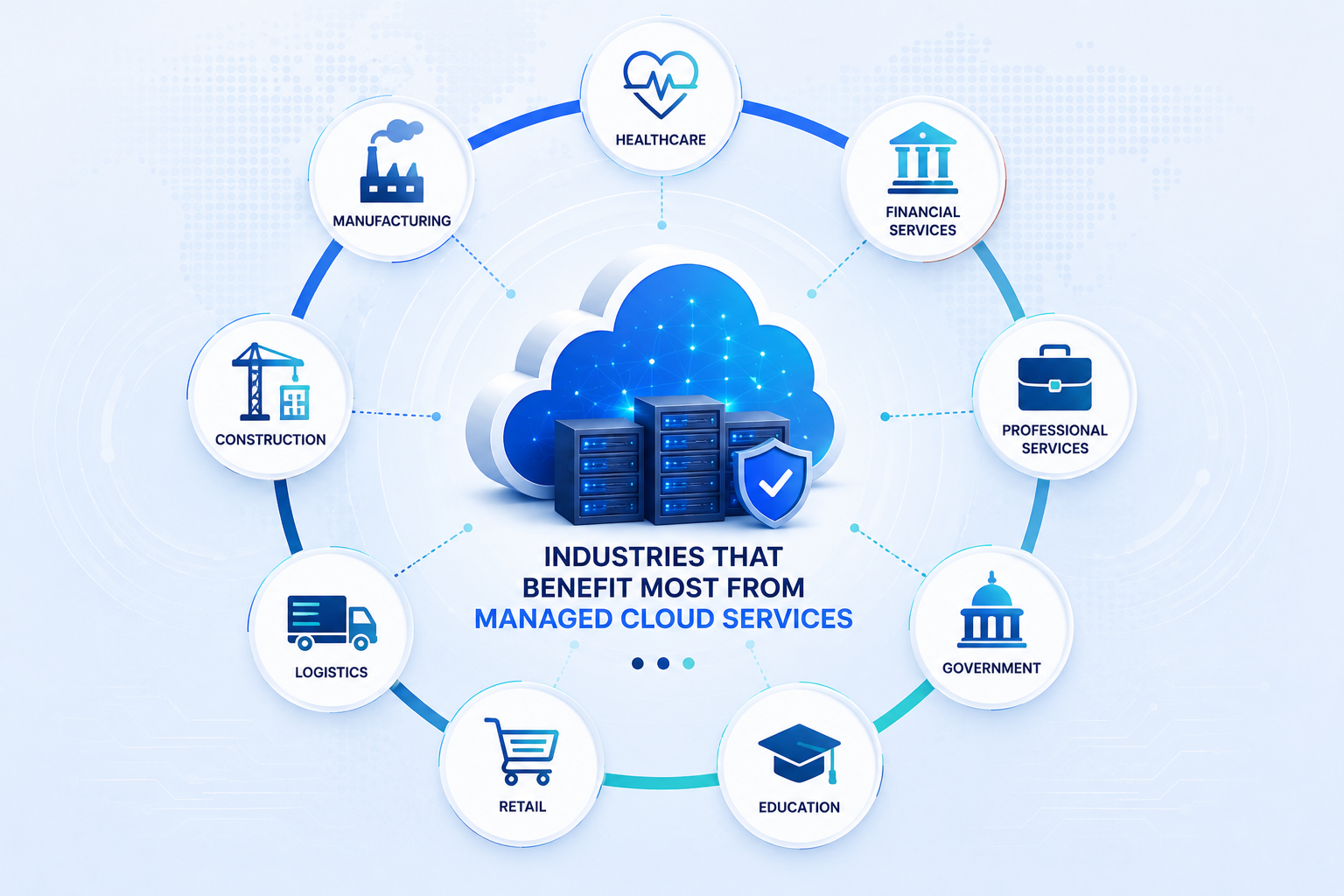
Healthcare
Healthcare organizations require secure access to clinical systems, electronic records, scheduling platforms, and communication tools. Managed cloud services improve availability while supporting secure information management and business continuity planning.
Manufacturing
Manufacturers increasingly connect production systems, inventory platforms, enterprise resource planning software, and supply chain applications through cloud infrastructure. Managed services improve operational visibility while supporting system reliability across multiple facilities.
Financial Services
Financial institutions depend on secure infrastructure that supports transaction processing, customer services, reporting, and regulatory obligations. Managed cloud environments provide continuous monitoring and strong security controls that help reduce operational risk.
Professional Services
Law firms, accounting firms, engineering organizations, and consulting companies require secure collaboration tools, document management systems, and reliable remote access. Managed cloud environments simplify infrastructure administration while improving productivity.
Government
Government agencies often maintain extensive digital services that require high availability, structured governance, and reliable disaster recovery planning. Managed services support operational continuity while improving infrastructure management.
Education
Educational institutions rely on cloud platforms for learning management systems, administrative applications, research environments, and collaboration technologies. Managed services improve system performance while supporting growing user populations.
Retail
Retail businesses depend on inventory management, ecommerce platforms, payment processing, and customer engagement systems. Managed cloud infrastructure supports seasonal demand while maintaining application availability.
Logistics
Transportation and logistics companies require real-time visibility across routing systems, warehouse operations, fleet management, and customer communications. Managed services help maintain infrastructure performance throughout distributed operations.
Construction
Construction firms increasingly use cloud applications for project management, scheduling, procurement, documentation, and field collaboration. Managed cloud environments provide secure access for office personnel and remote project teams.
How Managed Cloud Services Improve Business Performance
Technology infrastructure directly influences operational efficiency. Reliable cloud environments reduce disruptions while enabling employees to work more effectively across departments.
Reducing Downtime
Continuous monitoring identifies potential infrastructure issues before they interrupt business operations. Preventing downtime helps organizations maintain productivity, customer satisfaction, and revenue generation.
Improving Employee Productivity
Reliable access to applications allows employees to complete work without unnecessary delays caused by infrastructure failures or system instability.
Supporting Digital Transformation
Organizations adopting automation, analytics, artificial intelligence, and modern business applications require scalable infrastructure to support evolving technologies. Managed cloud services provide the operational foundation for these initiatives.
Predictable IT Budgeting
Managed service agreements often simplify technology budgeting by replacing unpredictable infrastructure repair costs with more consistent operational expenses.
Faster Deployment of New Applications
Cloud environments allow organizations to provision infrastructure more quickly than traditional hardware deployments. New applications can often be deployed in significantly less time, accelerating business initiatives.
Scalable Growth
As organizations expand into new markets, increase staffing, or launch additional services, cloud infrastructure can grow alongside business requirements without extensive hardware investments.
Common Mistakes Businesses Make When Moving to the Cloud
Successful cloud adoption requires planning, governance, and ongoing management. Organizations that underestimate these requirements often experience avoidable operational challenges.
Common mistakes include:
- Treating migration as only a technology project instead of a business initiative.
- Selecting cloud platforms without evaluating long-term operational requirements.
- Failing to establish comprehensive security policies before migration.
- Ignoring backup and disaster recovery planning.
- Migrating workloads without assessing application dependencies.
- Choosing providers based primarily on cost rather than operational capabilities.
- Neglecting user training and change management.
- Failing to monitor cloud environments after deployment.
- Overlooking compliance and data residency requirements.
- Expanding cloud resources without governance or cost optimization.
Avoiding these mistakes helps organizations achieve greater value from their cloud investments while reducing long-term operational risks.
Future Trends Shaping Managed Cloud Services in Canada
Cloud technologies continue evolving as organizations adopt increasingly sophisticated digital strategies. Managed service providers play an important role in helping businesses implement these innovations while maintaining operational stability.
AI-Driven Cloud Management
Artificial intelligence increasingly assists providers by identifying infrastructure anomalies, predicting failures, optimizing resource allocation, and accelerating incident response.
Automation and Orchestration
Automation reduces repetitive administrative tasks such as provisioning, configuration management, software deployment, and routine maintenance. This improves operational consistency while reducing manual effort.
Zero Trust Security
Organizations continue to strengthen security by verifying every user, device, and application, regardless of network location. Zero trust architectures reduce unnecessary access while improving overall protection.
Edge Computing
Applications requiring low latency increasingly process information closer to users or operational facilities. Edge computing complements centralized cloud infrastructure by improving responsiveness for specific workloads.
Sustainability Initiatives
Businesses continue evaluating energy-efficient infrastructure and resource optimization practices that reduce environmental impact while improving operational efficiency.
Hybrid Work Infrastructure
As flexible work models continue evolving, organizations require secure cloud environments capable of supporting employees across multiple locations without compromising security or performance.
Increasing Regulatory Requirements
Privacy expectations and regulatory obligations continue expanding. Managed service providers help organizations adapt operational practices to support changing governance requirements and evolving cybersecurity standards.
Conclusion
Cloud technology has become an essential component of modern business operations, but successful cloud adoption depends on more than infrastructure alone. Organizations require continuous monitoring, proactive maintenance, cybersecurity expertise, disaster recovery planning, and performance optimization to keep business systems operating efficiently.
Partnering with an experienced managed cloud service provider enables businesses to reduce operational complexity while improving reliability, scalability, and long-term resilience. From infrastructure management and security to backup strategies and hybrid cloud support, managed services provide the expertise needed to maintain stable and secure IT environments.
As organizations continue to expand their digital capabilities, investing in managed cloud hosting and comprehensive managed cloud services provides a practical foundation for sustainable growth. Businesses evaluating managed cloud services in Canada should focus on providers that offer technical expertise, proactive support, robust security practices, and scalable solutions aligned with long-term business objectives.
Frequently Asked Questions
What is the difference between managed cloud services and cloud hosting?
Cloud hosting provides the underlying computing infrastructure, while managed cloud services include ongoing administration, security management, monitoring, optimization, maintenance, and technical support for that infrastructure.
Why are managed cloud services important for Canadian businesses?
Managed cloud services help Canadian businesses improve cybersecurity, maintain business continuity, support regulatory compliance, reduce infrastructure management workloads, and scale technology resources more efficiently.
How do managed cloud hosting services improve disaster recovery?
Managed cloud hosting services integrate automated backups, redundant infrastructure, documented recovery procedures, and recovery testing to help organizations restore operations quickly after unexpected disruptions.
How do businesses choose the right managed cloud service provider?
Businesses should evaluate technical expertise, security capabilities, support responsiveness, service-level agreements, compliance experience, disaster-recovery capabilities, and long-term scalability before selecting a provider.